
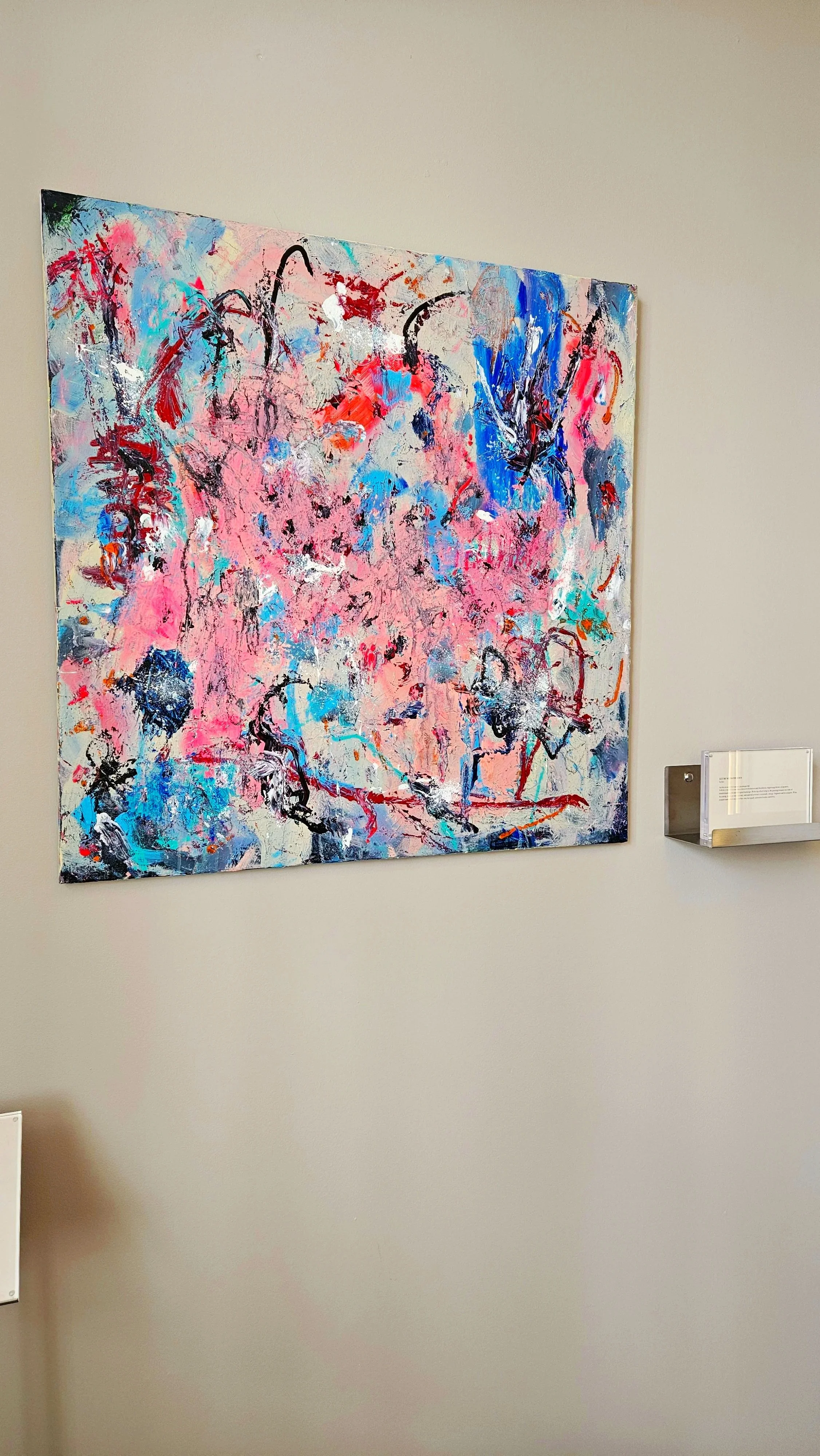
The Mask vs. The Essence (The Echo of Alienation and the Sanctity of the Self)
In the context of my practice, "You almost convinced me I was real" serves as a profound statement about alienation and the vulnerability of human existence. It addresses the subtle, insidious velocity with which we allow the external world to construct a counterfeit version of who we are. The "You" in this text is not an individual person; rather, it is the collective gravity of everything outside the Self. It is the reflection of public identity—the neat, linear stories told to explain a life, such as geographic transitions or biographical timelines, and the polished, palatable surface presented to society in order to belong.
At the absolute centre of this work is a fierce, uncompromising defence of the march of the Self. The Self is not a fixed, easily summarized object; it is a vibrant, shifting cosmos of energy driven by continual transformation, memory, instinct, and raw emotion. However, the external world demands order. It asks us to freeze this perpetual evolution and flatten our psychological topography into readable biographies, static roles, and smooth personas. I capture the exact, dizzying moment of existential vertigo where a force wakes up, looks at this well-constructed external reflection, and realizes it has been lulled into a beautiful compliance. It is the moment the true Self looks at the mask it has been wearing and says, "I almost believed that was me."
By placing this haunting confession directly alongside my work, I am warning us about the terrifying ease with which we can become spectators to our own existence, falling asleep to our own depth and halting our inner growth. I assert that the true, ever-evolving Self cannot be neatly categorized or perceived from the outside. To survive, the inner essence must violently reject the comforting illusion of the polished persona. It must stage a quiet, poetic rebellion against its own reflection, reclaiming its right to remain beautifully intricate, deeply layered, uncharted, and—above all things—profoundly authentic.
This psychological warfare is precisely what materializes on the canvas. There exists a threshold in the creative act where the conscious mind collapses under its own weight, dissolving the fragile boundary between the artist and the medium. In this state of absolute surrender, the ego goes quiet, transforming the creator into a raw conduit for a vital, divine force that rises from deep within. To create from this depth is no longer an act of deliberation, but a visceral channelling—a brief, lightning-fast convergence with a sacred strength where the artwork is dictated rather than designed. It is art stripped back to its terrifying, primordial roots, leaving behind a physical artefact that vibrates with the heavy, undeniable frequency of the unknown.
Consequently, my paintings do not merely occupy a room; they arrest it. The canvas becomes a site of poetic resistance, flatly rejecting compliance and injecting a raw, visceral energy into the space it inhabits. To stand in front of these works becomes a ritual—a direct call to the Self wrapped in the silent hope that the canvas will unlock something buried deep within you. They act as a profound visual fracture in the surface of our controlled environments, forcing the viewer to pause, step back from the comfort of the predictable, and finally confront the unmapped, sacred depth of their own existence.
Everything else out there is managed. But right here, in front of this canvas, you are allowed to be entirely human.